
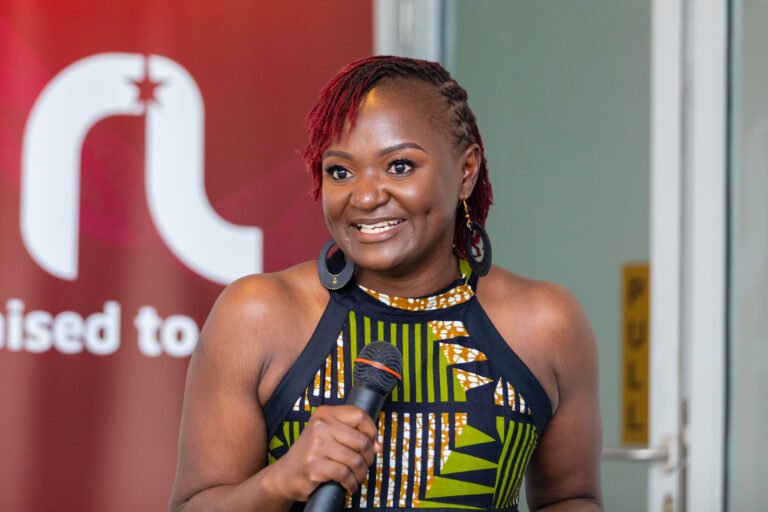
When my mother delivered her third girl, a relative was dispatched to the hospital to check if it was a boy this time. When the person went back to report to my grandmother, it is reported that she said, “There is no child there, just another ogwang.” Ogwang, in the tongue of our people, is a wild cat. It’s an animal that lives in the bush, eats from the bush, and belongs to the bush. If you see an ogwang, you don’t take a photo of it—you throw a stone at it. That’s what we were in the eyes of my extended family.
My mother lost two boys and had four daughters. Four wild cats. That’s all we were, apart from our brother, James. That’s all we were meant to be, had my dad let this narrative go on. It’s virtually impossible to talk about my life without talking about my father. He was the blueprint of my life. Still is.
My dad was called Charles Booker Okore
Some people called him Engineer, others called him OBC or Telo, to mean “the government.” Most people just knew him as Wuon Aquino. I’m Aquino, for any avoidance of doubt. We grew up in a village called Sinyolo, that’s all the way in Kisumu, North Kapuonja. Green hills, valleys, winding dirt roads, chilly mornings, the smell of wood smoke. Maybe your village is like mine. Of course, it was patriarchal. As a woman, giving birth to boys gave you some sort of validation, acceptance, street cred—or village cred in this sense. My mother wasn’t supposed to have any village cred, with four girls, four ogwangs. My father gave her village cred by standing by her and in essence by standing by us.
And if my father stood by you, no force on earth would move him.
Dad came from nothing—as a fifth child in a polygamous family with thirteen siblings, his chances of making it out were dismal to nothing. But he was destined to overcome challenges. He worked hard and found himself at Starehe Boys Center. I don’t know if you fully appreciate how far North Kapuonja is from Starehe. It took brains and blood to get there as a boy from Sinyolo, and my dad had that grit. Because he met great influences like the late Dr. William Griffin, who planted seeds in him, he wanted the same for his children. For his wild cats. But he also educated his siblings while working at Kenya Post and Telecommunications Company.
I went to Jack and Jill primary school in Kitale. We couldn’t afford Jack and Jill. That wasn’t the school for people like me. It was such a wild departure from what I knew or what I was accustomed to. My classmates frequently spoke of vacations they took. It’s the first time I ever heard of a vacation. It was a struggle fitting in, and I didn’t know then what my dad was doing. He was there, in presence and in the form of a voice in my head, encouraging me.
He never missed one visiting day, always there with his newspaper and a bag of fish and chips. We would sit under a tree and talk about this new school and my new experiences. I was struggling. I felt like an imposter. I didn’t belong. “You do you,” he would insist. “You belong anywhere.” My grades dipped, but then he constantly affirmed my place at that school and they started improving. Before long I was in the top ten performers. I was the best in math but struggling with languages, which I worked on relentlessly with his urging. Unbeknownst to me, he was dealing with his pressure around him, around the society, people who were talking about how he was wasting his time and money with his girls who would likely end up pregnant or married. It must have taken a lot from him to go against the grain, to ignore this jabbering, to stay the course.
All I have achieved, all the rooms I have been in that I felt I didn’t belong in, was because of my father’s faith in me. He affirmed every dream I had. He was the mast in my sail.
When I got pregnant, I was so gutted that I had disappointed my dad. I knew he would have loved to send me off with a big wedding. So I kept it under my hat. When my pregnancy got so complicated and I was being taken to surgery, when he heard the news he got on the immediate bus in the village. By 7 PM he was seated by my bed, holding my son with pride. I wondered why I couldn’t have just told him. My apprehension felt juvenile, silly. He looked up and said, “You will name him after me.”
Charles Booker Okore, what a man.
My dad had a car, but it wasn’t just his car. It was a communal car—it ferried villagers to hospitals, weddings, and funerals. The official music of his car and in our home was rumba music. In fact, the soundtrack of my life, of our lives, is rumba music.
We made many memories of him in that car. He sang Lingala parts and told us the history of our nicknames. He called one of my sisters La Vie des Hommes and my other sister Tigress. I was called Mamou, because of his favorite song by Franco called Mamou. When my sister had done well in school, he’d call her Dana, after my grandmother. When I had an academic win, I was Nyarbwana. Dad showed us off. He’d tell his friends, “This one is going to be a professor, this one is a minister in waiting.” He’d tell us, “You are the best children I ever had.” Constantly. Nothing was too small to celebrate. No word was too heavy to lay on us. One time a man, a tout, at Kisumu bus station crossed a line with my sister, and my dad drove for an hour and went looking for him. When he didn’t find him, he told his friends, “Tell him I was here. And I will keep coming here until I drive him out of this town.” He would go to war for us. That was never in question.
Charles Booker Okore.
He wasn’t just about money—though times were financially tough—my dad had a gift for bringing people together and seeing possibilities where others saw nothing. He rallied people, family, friends and even strangers to come together and do different things like paying school fees for the less privileged, paying hospital bills and even investing in his backyard. In turn, this empowered, people, created job opportunities, and growth in the community.
He read all my work contracts. He was there for all my achievements and moments of indecision. He was my rock that I could lean on. Walking through life, I always knew that my dad was there if I stumbled.
On Wednesday, 11th May 2022 at 15:11, Charles Booker Okore departed after a long illness, bravely borne in his fashion.
Dad left us with so much. He gave his community so much. He did so much and he is missed so much.
I know of no other home than my father’s home. Home is everything to us because dad made it so. We went home when we won and we went home when we lost. You are heartbroken and you go home. We get married, we go home. When the world is cruel, you go home. Because home was safe and home accepted us. Home was dad. He reminded us in words and action that if the world was cruel, we would still have a home, a place to rebuild.
I don’t think we talk about fathers enough. I don’t think we appreciate the role they play so that we can do what we do and stand in rooms like this and share and celebrate.
My father refused to let the world diminish us, and in doing so, he showed us how to refuse it too. Every time I walk into a boardroom, every time I negotiate a contract, every time I stand before a crowd and speak my truth, I carry his voice with me: “You belong anywhere.” That is the gift of a father who believes—not just in what you are, but in what you can become. That is the gift my father gave, not just his four daughters and son, but to a village, to a community, to everyone whose path he crossed.
My dad believed in me, that’s how he taught me to believe in myself. That was, in many ways, a demonstration of one form of leadership. But his leadership went far beyond our home. He showed us that true leadership means mobilizing people for causes greater than yourself. He also demonstrated that leadership meant rejecting limiting beliefs about what women can achieve, choosing instead to invest in potential others couldn’t see. He taught me that leadership is showing up consistently, whether it’s never missing a visiting day or driving through the night when your child needs you. Most importantly, he showed me that believing in someone isn’t just encouragement—it’s an act of leadership that creates leaders. Brings to mind that expression we like to use; iron sharpens iron.
However, this story isn’t just about my dad. It feels bigger.
It’s about celebrating the fathers who choose to show up in ordinary and extraordinary ways. Fathers who make homes safe and create belonging so their children can walk boldly into the world. Fathers who teach their sons and daughters to believe in themselves, to reach for, and serve something greater. The truest test of leadership, I think for me, is not how many follow you, but how many you inspire to lead. I’m a product of the latter, thanks to my father.